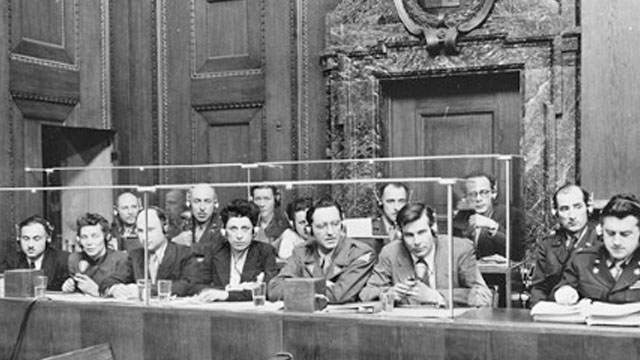
The Nuremburg Trials began on November 20, 1945 and so did Simultaneous Interpretation. Up to this point consecutive interpretation had been the conventional mode of interpretation. However, providing interpretation for the four European languages involved--German, French, English, and Russian--made it essential for another methodology of interpretation to take place in order for the Nuremburg trials to take place at a reasonable pace of time.
A PBS article describes precisely how simultaneous interpretation worked at the Nuremburg Trials: "Boston businessman Edward Filene had created a simultaneous interpretation system in which prepared speeches were translated prior to the event and read simultaneously in the various languages. Later, an American company, I.B.M. acquired the patent and modified the system. At Nuremberg a system of five channels of translation allowed for unscripted exchange at the trial. One channel sent out the exact words of the speaker; other channels transmitted immediate translations in English, Russian, French, and German. Participants listened on headphones and could choose from among the channels. Six microphones picked up the extemporaneous speech of the judges, witnesses and others from the speaker's podium and sent out simultaneous interpretations over the channels."
If you are interested in learning more about this history, two very interesting podcasts are available from BBC and the World:
1. BBC | In Other Words
2. The World | How the Nuremburg Trials Changed Interpretation Forever
This website uses cookies to improve your experience. We'll assume you're ok with this, but you can opt-out if you wish. Cookie settingsACCEPT
Privacy & Cookies Policy
Privacy Overview
This website uses cookies to improve your experience while you navigate through the website. Out of these, the cookies that are categorized as necessary are stored on your browser as they are essential for the working of basic functionalities of the website. We also use third-party cookies that help us analyze and understand how you use this website. These cookies will be stored in your browser only with your consent. You also have the option to opt-out of these cookies. But opting out of some of these cookies may affect your browsing experience.
Necessary cookies are absolutely essential for the website to function properly. This category only includes cookies that ensures basic functionalities and security features of the website. These cookies do not store any personal information.
Any cookies that may not be particularly necessary for the website to function and is used specifically to collect user personal data via analytics, ads, other embedded contents are termed as non-necessary cookies. It is mandatory to procure user consent prior to running these cookies on your website.